
Many people asked us why we were going to copenhagen and what we hoped to achieve out of it. obviously we weren't going to change the course of the discussions but i think most people like us wanted to go there to raise our voice, join the group and meet other people with whom we can share ideas. So that, while the politicians bicker about carbon footprtins, we can start doing our own things and making our own progress.
That's pretty much what we did. We went on the march and, as it happened, we were near the front of the crowd so we were basically walking in front of hundreds of photographers for most of the journey. The press were clearly waiting for a riot so they can take that prize-winning photograph. They got their chance later in the evening, after the march, when a bunch of people threw stones at the ministry of foreign affairs. The police charged in, arrested everyone in sight, and the press were happy. When we looked at the newspaper the next day, it seemed like a war had taken place. It was quite the opposite. We walked quietly to the conference centre where we were then lulled into boredom by a dj who played buddha bar lounge music instead of some energetic metal or rock to get things going. We didnt see the people throwing stones and as far as i know they were protesting about deportation.
So we went to christiania instead. Its a cool place but its not what i expected of an alternative town. Its more like the Tacheles in berlin, which means its quite punk and you can see the squater influence.
On the way back, in the metro station, we bumped to someone we recognised from nora's uni. They missed the march because the bus got held up (probably deliberately - which would be unsurprising). We told them about the march and... they asked how we got to copenhagen. We said we flew. That didn't go down well at all.
We were travelling on the same metro so they asked us if were staying in accomodation with them (i.e. a matresses in a school hall). No thanks, we were hosted by a friendly couple in awesome flat and there was actually a surplus of hosts so they could've done that too. Then they started getting really ratty and self righteous about everything. By implication, we should've asked them why they were taking the metro - they should've walked back to their accomodation!
Sharing ideas:
There are plenty of eco-villages around europe that are doing the right thing: growing their own healthy food, living self-sufficiently, sustainably and happily. People were sharing information, tips and advice. We also watched a video about totnes being a "transistion town".
Copenhagen:
We stayed with jan and john who had an awesome flat and just what we expected a danish flat to look like: spacious, minimalist yet cosy and comfortable. They hosted us for three nights and we got on together like a house on fire. We cooked for eachother, talked about languages and all sorts. Both spoke ridiculously good, accent-free, english as well many other langauges. They were a pleasure to be with and we had a good laugh.
We saw plenty of copenhagen. I think the one thing that struck me the most was how many independent shops there were. Its refreshing compared to the same streets throughout the whole of england. In fact, the whole city is refreshing, really. Its spacious, uncluttered, clean, quiet and beautiful!
Tuesday, December 15, 2009

Thursday, April 16, 2009
Here are a few photos from Oman
 A small omani village in an oasis near the Wahiba Sands. It was very hot and very quiet. Only a few crickets chirped in the long dry grass.

A desert camp just inside of the Wahiba Sands. We stayed in a Beduin hut. We spent most of the evening lounging about in a communal sitting area filled with carpets and floor pillows. An ideal place to drink chai, eat dates and listen to desert's silence.

This is a wadi - essentially, a rather dried-up river bed where warm water springs out of the mountain.
 Arabic cligraphy.
 The grand mosque with confident elegance.
Thursday, March 19, 2009
in-house compost
I really enjoyed reading about sustainable dave's mission to not throw away any rubbish for one year. An interesting blog for people who live in cities where there is no recycling scheme or recycling possibilities. Provides plenty of inspiration and tips.
Among other things, I was really interested in the worm composter - which can be kept indoors. Best to let him explain it...
Among other things, I was really interested in the worm composter - which can be kept indoors. Best to let him explain it...
Friday, February 6, 2009
what are you eating?
Genetically Modified Organisms (GMO) are, in my opinion, one of the most important predicaments facing us today. The issue is never reported so it has become quite esoteric and not many people know much about it.
Pessimistically, GMOs, in the form of GM food, could one day affect everybody. To avoid this scenario, it should concern everybody to know more about the health risks, environmental damage and the cynical politics that pushes and sponsors the growing of GM crops throughout the world.
I have been reading and researching this for roughly half a year and it’s about time to write some stuff…
Part 1 - The “science”
How are GMOs developed? Although the GMOs are developed in the laboratory, there is nothing scientific about it. By this I mean, the process is not calculated, controllable or even safe.
Scientists will look for certain characteristics in animals, plants, insects or even bacteria and identify a strand of DNA responsible for this unique (evolutionary) characteristic.
A particle gun is then used to randomly fire this strand at another organism’s DNA, in the hope that new organism will adopt the strand’s characteristic. This process will be done hundreds of times until the desired outcome (usually a plant) morphs out the test tube - which will be a new organism and immediately patented.
This process is random, so the scientists have no idea what else may have happened to the DNA - for example, the modified DNA could be ever so slightly damaged, or new proteins are unknowingly created - with unknown health consequences. The modified DNA turns out to be about 2-4% different from the original DNA - which doesn’t sound like much. But, to put this into perspective, the difference in DNA between a human and a monkey is less than 1%.
This is the same science behind GM crops, such as wheat and rice - both increasingly and forcedly grown in the developing world to feed millions of people.
The countless health and environmental risks as well as political ramifications from “owning the seed” will be mentioned later:
Part 2 - Your health
Part 3 - Our environment and how GMOs are spreading.
Part 4 - The politics: “control the oil and you control the countries. Control the food and you control the people”.
Monday, January 26, 2009
Binta y la gran idea (Javier Fesser 2004)
A beautiful short film that turns what may be our idea of development completely upside-down.
Who said that the western way of doing things is the right one? It's about time we start questioning that!
The film is in French with Spanish subtitles and it is part of a collection of short films produced for Unicef titled "En el mundo, a cada rato".
Watch it here
Who said that the western way of doing things is the right one? It's about time we start questioning that!
The film is in French with Spanish subtitles and it is part of a collection of short films produced for Unicef titled "En el mundo, a cada rato".
Watch it here
Tuesday, December 9, 2008
Venus Project
The Venus Project, which is a group of architects and philosophers based in Florida, seems to have designed plans for a future civilization that sound relatively similar to the goals of Auroville.
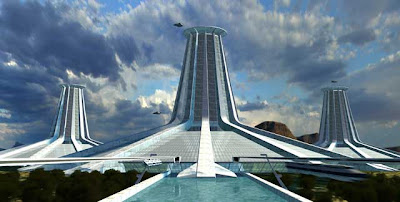
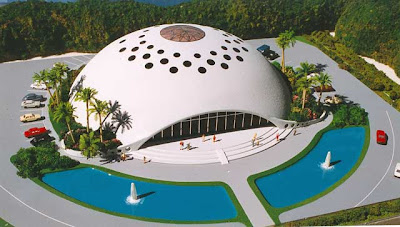

I think at the heart of the Venus Project is: technological development and a resource-based economy (instead of the current monetary-based system). The technological advancement aims to fulfill every human being's needs: food, shelter, trasportation, health, energy and education - all of which are currently subject to costs. In our monetarist system, the more scarce or valuable these products become, the higher the price (profits) will be - and so the argument goes that the monetarist system stifles advancement and actively encourages scarcity. Most of the technology and resources to fulfill these needs are already availiable, but costs are a hinderance so a resource-based economy would be condusive to these goals (and has many other positive by-products).
Auroville is more concerned with the spiritual advancement of mankind - which may also be the outcome of the Venus Project once all mundane jobs are eliminated by technology. Officially, Auroville doesn't have any money in circulation but works on a debit basis. While there, we never walked round with many rupees - but we still had to buy things with an account number. The resource-based economy is all-or-nothing - and probably won't function until you are 100% self-sufficient as a civilisation.
The architecture looks similar to Auroville as well! White, curved buildings with palm trees!
www.thevenusproject.com See the other entries for pictures of Auroville.
Sunday, November 30, 2008
The story of stuff
This is one of Neal's findings, a friendly video about our unsustainable patterns of consumption. Yes, you have heard it all before. But this is a very didactic account, easy to understand and not just over-simplified or complicated green propaganda.
Video

Video

Monday, November 24, 2008
Integration through music
L'Orchestra di Piazza Vitorio started as a way of integrating immigrants of different origins into their small neighbourhood in Rome. It was one mighty project to find professional musicians, who in their host country were disguised as cooks, rubbish collectors or street vendors.
After struggles to receive visas, securing funding, finding a place to rehearse and through much determination, in the end instruments, rythms and lyrics from the four corners of the world, come together in vibrant pieces of music.
After struggles to receive visas, securing funding, finding a place to rehearse and through much determination, in the end instruments, rythms and lyrics from the four corners of the world, come together in vibrant pieces of music.
This orchestra's story is touching and inspiring. Watch it if you have the chance.

Their website
My favourite song
Sunday, November 23, 2008
Water - bottled or from the tap?
Mineral water is taken from the springs, at re-birth. But the expert reassures me. The water that we get at home from our taps, is not only perfectly safe to drink, it also has a good balance of the minerals our bodies need.
Water purification processes are well advanced in this part of the world. In lucky mountainous countries, the water only needs bit of chlorine to make sure there are no impurities left. In countries crossed by rivers at the end of their course, after visiting factories, nuclear plants, farms, crops and abattoirs, the treatment includes more chemicals (ozone and oxigen) and filtration through sand and activated carbon. All the contamination is removed: pesticides, traces of medicines, hormones from the anti-contraceptive pill... By the time water arrives at our taps it is pristine. But this does not mean that is stays this way in the rivers, before and after the water purification plant!
Some bits of advice,
- If you prefer to drink mineral water, change brands every so often. Each one has a different composition of minerals and by drinking different waters there will be no deficiencies.
- Think of all the plastic bottles you are using and buy glass ones instead. Be careful of reusing plastic bottles too many times. When plastic is exposed to sunlight (wether on your desk or earlier on its way to the warehouse) it leaches some of its chemicals into the water you will drink. With glass you are safe
- Some companies are bottling tap water and selling it as mineral water. EVIAN-NAIVE, it makes you wander. :o)
- The water companies are only responsible for the water they provide, up to your counter. If you live in an old house, you should check your water pipes are not still old lead-pipes, that you could be drinking.
Cheers!
Wednesday, November 19, 2008
Grass doesn't grow quicker if you pull at it
Exercise and development: Humans grow from infants to adults in the same way that a tree grows from a seedling. Only humans are in a hurry, for some reason.

Here are some points that have recently helped me re-understand why one should do training, reconfirmed its benefits and reassured me about progression and development in sport and other things in life. From Dan Millman's Body Mind Mastery:
- development follows demand. Without demand, no development.
- progression should be natural. All living things thrive in natural moderations and balance. This also applies to the mind and body
- Exercise should be performed near the top of the 'comfort zone' but not over. Constant over-exursion in training results in extreme exhaustion, fatigue and injury. Ultimately, in burn-out. Stretch the comfort zone with small increments. Improvement is slower but lasts longer.
- Don't get too over-obsessed or sidetracked by the goals and time deadlines. Some goals are important - but time deadlines are arbitrary. Also, remember why you are doing the sport in the first place.
- Stress happens when the mind resits what is. Don't try. Don't try to do things (causes tension in muscles) or try to resit things that happen to you. Secret of efficiency = maximum activity during maximum relaxation.
Wednesday, November 5, 2008
Milk
I was once reading an article about milk. It said that some tribes in Africa (the massai tribes) drink lots and lots of milk and have the lowest rate of heart disease among human beings. It sounds very convincing that milk must be "good for you". But I have since read that the article forgot to mention that the milk is first fermented with cowshit and then cow's blood. Also the masaai's average life span is 46 years. No wonder they dont get heart problems from cholestral. The article was also fermented with cowshit. Here's some food for thought that I got in a newsletter from a nutritionist (is that right?)
Did you know that:
- Milk is high in fat and cholesterol.
- The hormones and antibiotics fed to dairy cows to increase milk production end up in the milk which is sold and drunk by the consumer.
- Calcium in dairy products is not absorbed into the body as easily as that found in many plant foods like dark green leafy vegetables.
- Though dairy products are rich in calcium, the high protein content is acid yielding and results in calcium being leached out of the body. This is why people with calcium deficiency keep taking supplements despite taking plenty of milk.
- Osteoporosis occurs most commonly in countries where the most milk is consumed. Studies have concluded that exercise and a diet rich in vegetables ensures strong bones and not dairy foods.
- Diets rich in dairy products are associated with an increased risk of cancer, heart disease, obesity, diabetes, osteoporosis, constipation, indigestion, arthritis, asthma, acne, allergies, depression and iron deficiency.
- Cow’s milk is not a natural food for humans: many people are lactose intolerant or are affected by cow’s milk allergies.
- Every mammal produces milk only for its young and the protein and other nutrient contents are suitable for that animal’s growth only. Since we grow at a slower rate than calves, cow’s milk is not suitable. Even a calf does not drink its mother’s milk once its weaned, so why should we?
- Cow's milk has higher pesticide levels than most fruits and vegetables since cows feed on a high quantity of plants which are already contaminated with pesticides.
Of course, you have to read up on this and verify this for yourselves. You can start here: http://sharan-india.org/newsletter/SharanNewsletterNovember2008.html
Tuesday, October 21, 2008
small scale bio-gas energy plants

I've known Jeffrey Gale for a while now because I occasionally do some water colour painting with him. Originally, he's an architect who specialised in sustainable eco-projects. On his website, he published a design for bio-gas energy plant (above). About the plants:
"These plants can be built in new housing projects, sized appropriately. One medium-scale plant, served by a good P-H balance of kitchen wastes, lawn mowings and human toilet wastes (see note 1), can provide enough electricity and gas for up to 30 homes, as well as excellent organic compost and water effluent for use on gardens or allotments, or sold for neighbours and farmers locally. Fresh lawn mowings have one of the highest yields of methane gas of all organic wastes!
The decomposing of any organic wastes where air is present produces a majority of CO2 with little methane. So all landfills, compost heaps, septic tanks and most sewage works emit vast quantities of CO2 into our biosphere.
Meteorologists and cosmic scientists say that methane emissions are doing far more damage to our biosphere than CO2. Clearly there is also a huge opportunity now to lessen global warming and provide a highly efficient pollution free abundant source of decentralised energy for local communities in any part of the UK.
Unlike wind or solar power, Biogas does not rely on the whims of the weather, as it is completely reliable any season of the year. If these plants became widespread, they would also give a continuous supply of organic compost to boost organic farming, horticulture and gardening. The compost from my designs is semi dry and recoverable from lift out perforated metal trays, allowing water to gravitate to filter beds below. (Aerobic process.)
Windfarms and nuclear power are not the complete answer to our energy problems as these are inefficient and environmentally degrading."
Detailed images and further information can be found here: http://www.eco-architectureandplanning.com/permaculturedesign/index.html
Thursday, September 18, 2008
Must watch video
Really informative documentary/lecture. Its about the perceieved power that government has over us. In essence, their power lies purely in the use of words - and equally our ignorance.
- Think Free : Bursting Bubbles of Government Deception (88min)
http://video.google.ca/videoplay?docid=-7040453665540929835
- ThinkFree Presents : The Magnificent Deception (121min)
http://video.google.com/videoplay?docid=6729904244308031068
- Think Free : Bursting Bubbles of Government Deception (88min)
http://video.google.ca/videoplay?docid=-7040453665540929835
- ThinkFree Presents : The Magnificent Deception (121min)
http://video.google.com/videoplay?docid=6729904244308031068
Wednesday, August 20, 2008
Islamic banking - the future?

The fastest growing banking sector in the world, operates in 70 countries and will soon have a $1trillion of assets.
Islamic banking acts in accordance to the islamic principles and is completely different to western banking. Islam prohibits riba, interest earned by moneylenders and denounces gharar which is any type of speculation. Money is supposed to be an instrument of productivity (not a commodity in itself to create more money). Gambling is banned so hedge funds and private equities and all those derivatives are frowned upon. Instead the money needs to be linked to real investments. Additionally, investors are supposed to share the risk of the lender - effectively making them a partnership - in contradiction to western banking which is risk averse meaning it diversifies or transfers the risk.
Alhamdul'llah... It also incorporates other principles such as helping the poor, (quite the opposite approach to here) and funding the pilgrimage to mecca.
Supposedly, it challenges rogue economics because it doesnt fund gambling, drugs and alcohol (the devil is in the bottle, as the koran says) or - I guess you could argue the ultimate by-product of western capatalism- porn and prostitution.
I know that the bank of Oman offers a monthly raffle instead of interest. You can win a phat four wheel drive! But the best thing, in my opinion, is that islamic banking avoids speculation which is already starting to affect food prices in a big way. It also avoids trading in debt which led to the big subprime melt-down last summer. Lastly, without interest there would be no student loan with compound interest and, much more importantly, no third world debt (poor countries are paying off more interest than the loan itself).
Insha'allah, we'll see how altruistic the principles stay, after all they are dealing with money.
Monday, August 11, 2008
Staying clean
 or How to wash without buying lots of chemicals
In india, we washed the dishes with wood ash, for some time. It works quite well and historically, people used ash as a lye when making soap. Taking a half burnt log is a good way of cleaning the BBQ. Ash isnt reconmended to wash hands because it leaves the skin quite dry.
Another cool thing is reetha soap nuts. They are nuts from a tree (only grown in hot countries) and when soaked in water they release a soapy sap. Proven to be as effective as normal detergents, with the advantage that they are inexpensive, reusable and environmentally friendly (and suitable for people with senstive skin). You can throw them in the washing machine, dishwasher or bath tub. You wont find them in the shops so you will have to order online (someone usually sells them on ebay but make sure they are the shells only - nuts removed)
Alternatively, make your own ghanan soap with coconut oil:
Friday, August 8, 2008
eco-ghettos!

aparantly classical economics states that the answer to almost anything was to allow the forces of supply and demand do their job. And now that oil is so expensive, people are starting to realise that "eco-living" (whatever its called) is actually worthwhile and cleaner and a higher standard of living anyway. In this case, who cares if people are doing the right thing for the wrong reason!
Finally, America's "first fossil-free" neighbourhood is being built in Colorado. It looks good. But if its in the middle of nowhere - people still need to drive cars to buy food or go to Blockbuster's.
There's one in Stockholm (above) which is slap-bang in the centre. It seems to be well-kitted out with transport and energy. This is how the whole eco-system works: http://www.hammarbysjostad.se/inenglish/pdf/Hammarby_model_%20lowres_eng.pdf
I like the one in Freiburg and I hope to visit it. Its been around for years. 50% of the population dont have a car. After all, they need to pay 18,000 euros per year to park it! Sums it all up, doesnt it!
Tuesday, August 5, 2008
We feed the world
 Good documentary from Austria: We feed the world. Some points:
- Each day vienna throws away enough bread to feed the second largest city, graz.
- Within Europe, tomatoes are driven 3000km from the south of spain. Transport only constitutes 1% of the cost (...so why are higher food prices being blamed on the rise of oil?????) Also these subsidized tomatoes end up in West Africa for 1/3 of the price of local produce. The farmers cannot compete and emigrate to EU cities for work.
- In the Amazon, an area larger than france has been cleared to grow, among other things, soyabeens to feed chickens in Europe, usa and Japan. 25% of Brazils population suffers from mal-nutrition.
So how comes it that 100,000 people die every day of starvation and at the same time heart disease is the biggest killer in the western world. "Heart disease" is high colestrol - which arrises from eating too much meat.
 A view of Almeria, Spain, from space - 1975 and today. 25,ooo hectares of greenhouses where tomatoes are grown in artificial soil.
unsustainable "sustainable houses"
 Its good to see that sustainable houses can be stylish and dont have to be ramshackle hovels made of coke-cans and old tires like those by garbage warrior (which is also cool, I think). Homlifestyle.com make some nice pads - advertised as green, eco and sustainable etc etc, prefabricated and delivered by bio-fuel trucks, of course. Good website.
I am bit skeptical though. Obviosuly capatalising on the current green trends. Its advertised as a second home for guilt-ridden city-dwelleres - so is it "sustainable" if you're not supposed to live in it? It probably helps the buyers justify building their holiday home in the first place.
The garbage warrior however, shows us that if you want to live sustainably, you can't! Government, pressurised by the big utilities lobbies, dont want that. The companies need income for the shareholders - as we all found out with British gas about a week ago. If you build houses "off-grid" you will get sued.
The garbage warrior (a proper architect) builds houses from discarded materials and the utility bills cost a couple dollars a month. Why not! The houses look kinda funky if you like that style. I think its cool. Much cooler than a white-trash trailer made of sustainable oak for the nouveau-riche.
garbage warrior's "earthship":

Sunday, August 3, 2008
Rice
Some people were relatively shocked when they heard that Haitians had to eat "mud-cakes" (what a euphamism!) but nobody bothered asking why. Its very simple and unsurprising: debts and dependency.
Al Jazeera's Inside USA: Twenty years ago, Haiti produced enough rice to feed its population. Importing rice from other countries like the US was unheard of. Today, the country of less than 10 million people is the third largest importer of US rice in the world – 75 per cent of the rice eaten in Haiti is shipped in from the US.
Great for farmers in places like Arkansas and Missouri but devastating for farmers in the Artibonite valley, which used to be Haiti's rice bowl.
And now that Haiti is utterly dependent on imported food, the entire country is vulnerable to the mood swings of the global market. (often speculation see post below)
So when the price of rice doubled in the last year, the majority of Haitians, who live in bitter poverty, got slammed.
See also:
http://www.hartford-hwp.com/archives/43a/223.html
Friday, August 1, 2008
I've been flicking through "The complete book of self sufficiency" by John Seymour. Its a real page turner. Here is the foreword:
"... We can do things for ourselves or we can pay others to do them for us. These are the two 'systems' that support us; we might call them the 'self-reliance system' and the 'organization system'.
In the modern world, during the last hundred years or so, there has been an enormous and historically unique shift: away from self-reliance and towards organization. As a result people are becoming less self-reliant and more dependent than has ever been seen in history. They may claim to be more highly educated than any generation before them; but the fact remains that they cannot really do anything for themselves. They depend utterly on vastly complex organizations, on fantastic machinery, on larger and larger money incomes. What if there is a hold-up, a breakdown, a strike, or unemployment? Does the state provide all that is needed? In some cases, yes; in other cases, no. Many people fall through the meshes of the safety net; and what then? ... "
They suffer because they cannot help themselves. The book goes on to show us how to help ourselves by showing us how to bake bread, brew beer, grow crops for food or energy, build solar panels and water mills, keep livestock, compost, make bricks, smoke bacon, tan leather and so on for 300 pages. You can either live by this book (perfectly feasible) or as a reference to slowly become less dependent on these systems - which I think is a good idea.
Its definintely worth having. So here is a link to the same pdf that I downloaded:
http://rapidshare.com/files/109834236/The.Complete.Book.of.Self.Sufficiency.rar
Subscribe to:
Posts (Atom)