
Genetically Modified Organisms (GMO) are, in my opinion, one of the most important predicaments facing us today. The issue is never reported so it has become quite esoteric and not many people know much about it.
Pessimistically, GMOs, in the form of GM food, could one day affect everybody. To avoid this scenario, it should concern everybody to know more about the health risks, environmental damage and the cynical politics that pushes and sponsors the growing of GM crops throughout the world.
I have been reading and researching this for roughly half a year and it’s about time to write some stuff…
Part 1 - The “science”
How are GMOs developed? Although the GMOs are developed in the laboratory, there is nothing scientific about it. By this I mean, the process is not calculated, controllable or even safe.
Scientists will look for certain characteristics in animals, plants, insects or even bacteria and identify a strand of DNA responsible for this unique (evolutionary) characteristic.
A particle gun is then used to randomly fire this strand at another organism’s DNA, in the hope that new organism will adopt the strand’s characteristic. This process will be done hundreds of times until the desired outcome (usually a plant) morphs out the test tube - which will be a new organism and immediately patented.
This process is random, so the scientists have no idea what else may have happened to the DNA - for example, the modified DNA could be ever so slightly damaged, or new proteins are unknowingly created - with unknown health consequences. The modified DNA turns out to be about 2-4% different from the original DNA - which doesn’t sound like much. But, to put this into perspective, the difference in DNA between a human and a monkey is less than 1%.
This is the same science behind GM crops, such as wheat and rice - both increasingly and forcedly grown in the developing world to feed millions of people.
The countless health and environmental risks as well as political ramifications from “owning the seed” will be mentioned later:
Part 2 - Your health
Part 3 - Our environment and how GMOs are spreading.
Part 4 - The politics: “control the oil and you control the countries. Control the food and you control the people”.
Friday, February 6, 2009

Monday, January 26, 2009
Binta y la gran idea (Javier Fesser 2004)
A beautiful short film that turns what may be our idea of development completely upside-down.
Who said that the western way of doing things is the right one? It's about time we start questioning that!
The film is in French with Spanish subtitles and it is part of a collection of short films produced for Unicef titled "En el mundo, a cada rato".
Watch it here
Who said that the western way of doing things is the right one? It's about time we start questioning that!
The film is in French with Spanish subtitles and it is part of a collection of short films produced for Unicef titled "En el mundo, a cada rato".
Watch it here
Tuesday, December 9, 2008
Venus Project
The Venus Project, which is a group of architects and philosophers based in Florida, seems to have designed plans for a future civilization that sound relatively similar to the goals of Auroville.
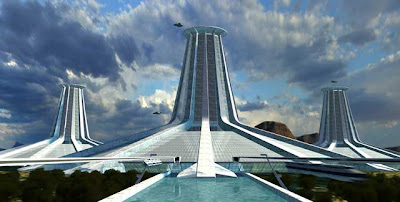
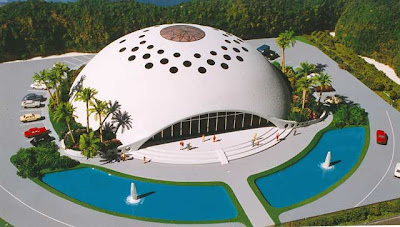

I think at the heart of the Venus Project is: technological development and a resource-based economy (instead of the current monetary-based system). The technological advancement aims to fulfill every human being's needs: food, shelter, trasportation, health, energy and education - all of which are currently subject to costs. In our monetarist system, the more scarce or valuable these products become, the higher the price (profits) will be - and so the argument goes that the monetarist system stifles advancement and actively encourages scarcity. Most of the technology and resources to fulfill these needs are already availiable, but costs are a hinderance so a resource-based economy would be condusive to these goals (and has many other positive by-products).
Auroville is more concerned with the spiritual advancement of mankind - which may also be the outcome of the Venus Project once all mundane jobs are eliminated by technology. Officially, Auroville doesn't have any money in circulation but works on a debit basis. While there, we never walked round with many rupees - but we still had to buy things with an account number. The resource-based economy is all-or-nothing - and probably won't function until you are 100% self-sufficient as a civilisation.
The architecture looks similar to Auroville as well! White, curved buildings with palm trees!
www.thevenusproject.com See the other entries for pictures of Auroville.
Subscribe to:
Posts (Atom)